
Last verified: April 2026
The Default: Counter-Clockwise, Every Time
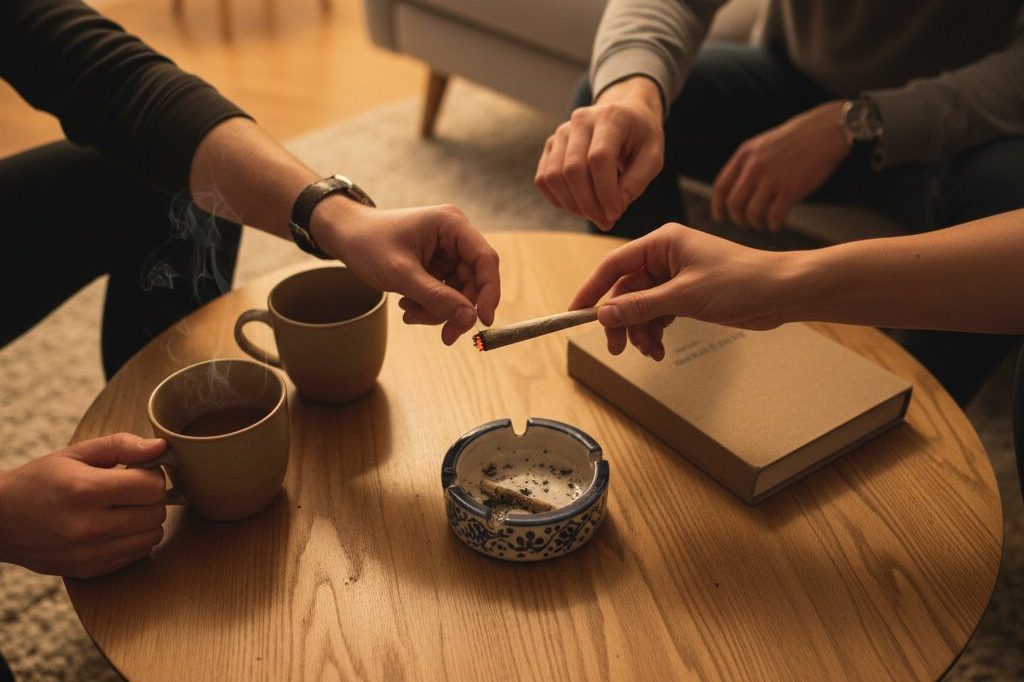
In most smoking circles, the joint moves to the left. That means from the person holding it, it goes to the person on their left-hand side — which, because everyone is facing inward, means the joint travels counter-clockwise around the circle. Once the rotation starts, it continues in that direction until the joint is done.
That is the convention. Where it came from is a more interesting story.
The Rastafarian Origin
The deepest and best-documented root is Rastafarian tradition. In Rastafarian reasoning sessions — long meditative conversations centered on scripture, Ethiopian history, and Afrocentric philosophy — cannabis is consumed as a sacrament. The chalice (a water pipe) or the spliff is passed communally. The passing is counter-clockwise, and the direction is not arbitrary: in Rastafarian cosmology, the left hand and counter-clockwise movement are associated with spiritual matters and with "peace," while clockwise passing is reserved for specific ceremonial contexts that carry different meanings.
When cannabis culture traveled from Jamaica into Britain, the United States, and eventually the world, the left-hand direction traveled with it.
"Pass the Dutchie" — How the Rule Hit the Charts
In 1982, the British reggae group Musical Youth released "Pass the Dutchie." The chorus — "pass the dutchie on the left-hand side" — hit number one in the UK and reached the top ten in the US. A generation of listeners learned the rule without knowing they were learning it.
The song itself is a family-friendly adaptation. Musical Youth reworked The Mighty Diamonds' 1981 track "Pass the Kouchie," replacing the kouchie (a Rastafarian chalice pipe) with the dutchie (a cooking pot from Jamaican patois) — because the band members were teenagers and the record label was nervous. The direction stayed the same. The rule was already universal enough in Rastafarian culture that it remained the one detail no one altered.
The Mighty Diamonds' 1981 "Pass the Kouchie" was itself a cover of a 1969 instrumental called "Full Up" by Sound Dimension. "Kouchie" is a Rastafarian term for the chalice water-pipe used in reasoning sessions. Musical Youth's pivot from "kouchie" to "dutchie" was not an attempt to scrub the cannabis meaning — anyone listening understood — but rather a sideways move that let the song get airplay.
The British Royal Navy Theory
A competing origin story, popular in etiquette-oriented writing, traces left-hand passing to the British Royal Navy's port tradition. At formal wardroom dinners, decanters of port wine are passed to the left — "port to port" — and never lifted off the table between guests. The joke is that the word "port" does double duty: the wine and the left-hand side of a ship.
Did American hippies in the 1960s know about Royal Navy port etiquette? Almost certainly not. But the convergence is interesting, and it's a story that gets repeated often enough to belong in any honest account.
The Practical Theory
A third, less romantic theory: most people are right-handed. Passing to the left means your right hand releases the joint while the next person's right hand receives it. The motion is cleaner. If you've ever tried to receive something with your left hand, you know how much less coordinated that feels.
This is probably how the tradition survived in non-Rastafarian, non-Navy American circles. Even smokers who had never heard of Jamaica or port wine ended up passing left because it was simply the most comfortable way to hand something to the person next to you.
Lizzie Post's Guidance — Direction Is Not the Point
In Higher Etiquette, Lizzie Post offers the most useful piece of advice on this question. What matters is not which direction the joint travels, but that it travels consistently in one direction. Her phrasing: "Pass in one direction, don't skip people, and don't forget to keep passing."
Her point: if you walk into a circle that is passing right, pass right. If it is passing left, pass left. The violation is not direction — it is inconsistency. Reversing direction mid-joint confuses everyone, creates awkward gaps, and breaks the rhythm of the rotation.
When Left Becomes Right
A few situations where the left-hand default gets adjusted:
- Someone is mid-sentence or mid-bite. Hold the joint for them and resume the direction once they're ready. Do not skip them and come back.
- The person on your left is sitting too far away. If the circle is geometrically awkward, pass to whoever is practically closest — and then the rotation continues in that new implied direction.
- The owner has already set a different direction. If the person who rolled the joint started it going right, go right. Their circle, their call.
- Rolling circles and factory-line sessions. When multiple joints are being rolled and passed simultaneously at a large gathering, people sometimes break into sub-circles with their own directions. Follow the sub-circle you're in.
The most common mistake is not going the "wrong" way — it's switching directions partway through a joint because you received it from an unexpected angle. If in doubt, ask one brief question: "which way are we going?" No one will judge you for asking. They will judge you for silently reversing the rotation.
A Word on Cultural Respect
Rastafarians did not invent cannabis, but they developed some of the most carefully thought-out communal rituals around it. When you pass a joint to the left, you are participating — consciously or not — in a practice that has spiritual weight inside the Rastafarian tradition. You do not need to be Rastafarian to follow the rule. But knowing where it came from is part of being a thoughtful guest in the culture.
See also: puff-puff-pass rules, roller's rights, and the session overview.
For in-depth cannabis education, dosing guides, safety information, and research summaries, visit our partner site TryCannabis.org