Last verified: April 2026
The First Impression
Walk into a well-run dispensary and the vibe is closer to an Apple Store than a head shop. Bright lighting, minimalist interior, polished counters, staff in branded shirts, digital menu boards, glass cases. The old tropes — smoky back rooms, bong-store aesthetics, tie-dye wall hangings — are mostly gone from modern licensed retail. What replaced them is a professional consumer-packaged-goods environment designed to normalize the category.
You’ll notice security is visible but low-key. A uniformed guard at the door, camera coverage throughout the retail floor, and either a glass security vestibule or a check-in counter. This is state regulation, not intimidation theater. Most states require two points of customer verification before any sale is rung up.
The Menu Wall
Digital menu boards along one wall typically break product into categories: flower, pre-rolls, vapes, concentrates, edibles, tinctures, topicals, and accessories. Each item shows strain name, weight or count, THC percentage, CBD percentage, often a terpene profile, and price. In medical-only states you may see additional columns for CBN, CBG, and other minor cannabinoids.
Flower is further broken down by type — indica, sativa, hybrid — though working budtenders will tell you those categories are folk taxonomy more than chemistry. Effects are driven more by terpene profile than by the indica/sativa label. Expect budtenders to talk about myrcene, limonene, pinene, caryophyllene rather than just “indica for sleep.”
The Display Cases
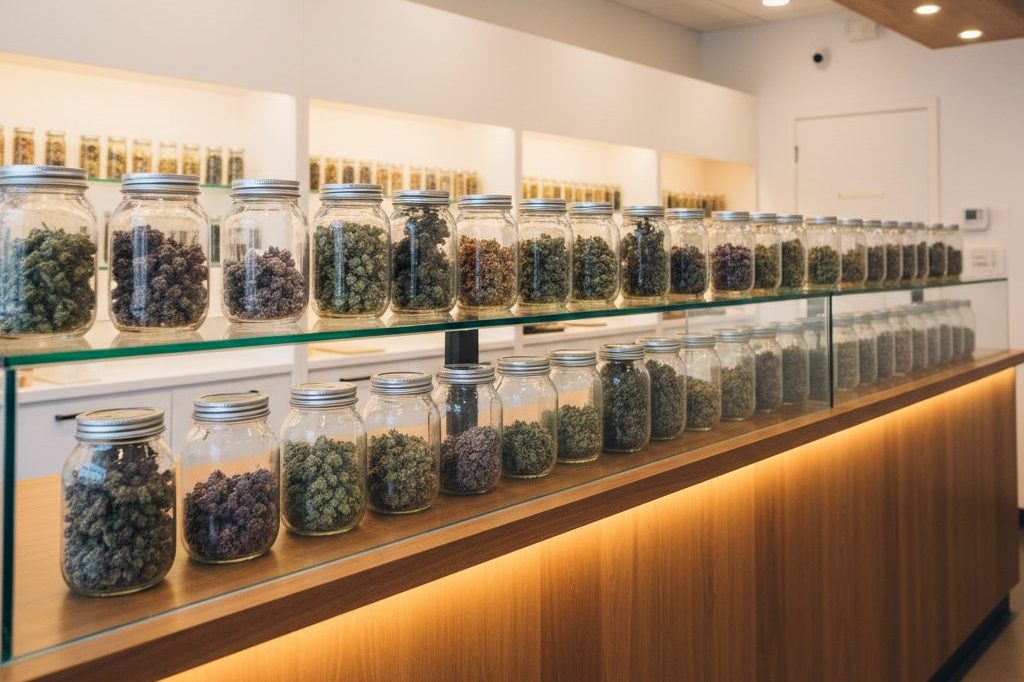
Most dispensaries still use locked glass cases where flower jars, concentrate containers, and packaged edibles are visible but not self-serve. You point, the budtender pulls. In many states (California, Nevada, Massachusetts), customers can smell flower samples from sealed pop-top jars — ask before you open one. In other states (New York, Illinois), regulation prohibits opening product on the floor and you’re buying based on terpene descriptions alone.
Concentrate cases are the most visually striking — rows of small glass jars holding rosin, live resin, diamonds, badder, and shatter in colors from pale straw to deep amber. Don’t start here on a first visit. Concentrates are two to four times more potent by weight than flower, and newcomer overconsumption of dabs is one of the most common greening-out scenarios. Read our guide on greening out before you buy one.
Watch how regulars interact with budtenders before your turn. You’ll pick up the conventions quickly — where the line forms, how long the average consult takes, whether people smell flower, whether tipping is common. Observation is the fastest etiquette teacher.
The Pace of the Visit
A typical visit runs 10 to 25 minutes from door to exit. Peak-hour waits (evenings, weekends, 4/20 and Green Wednesday) can push that to 45 minutes or more. Don’t schedule a dispensary stop as a five-minute errand unless you’re a regular with a saved order. The consultation is the product — rushing a budtender undercuts the entire reason the store exists.
At the counter, expect the following rhythm: greeting, ID check again (the state requires re-verification at point of sale), effect-based conversation, three or four product recommendations, your decision, a quick cross-sell (“pre-roll for the weekend?”), total, payment, exit bag, goodbye. The best budtenders handle this in eight minutes without rushing. The worst push whatever is on promotion without listening.
Who the Budtenders Are
Modern dispensary staff are typically 22 to 35 years old, formally trained through internal onboarding programs, and in many states required to hold a state-issued retail agent license. Larger chains (Curaleaf, Trulieve, Cresco) run multi-week training curricula covering cannabinoid science, product lines, drug interactions, and compliance. Smaller boutiques hire for knowledge and personality — some budtenders have been in the industry since the medical-only era and have 10+ years of experience reading customers.
They are not physicians. They cannot diagnose you or make clinical recommendations. What they can do — and do well — is translate “I want to feel less anxious at dinner with my in-laws” into a 5 mg edible, a 1:1 tincture, or a high-CBD pre-roll.
What the Vibe Isn’t
Dispensaries are not social spaces. You cannot consume on site in the vast majority of licensed retail locations — that requires a separate consumption-lounge license, which only 14 states plus D.C. have even authorized. You cannot bring friends in to hang out without ID. You cannot photograph the sales floor or the product (most dispensaries explicitly prohibit it for customer privacy and security; see our photos, kids, and pets guide). You will not be offered a free sample. You will not be handed a joint.
The vibe is friendly retail. Chat with the budtender, browse, ask questions, buy what you want, leave.
Leaving With Expectations Set
Expect the lab-tested, state-regulated flower you just bought to be stronger than anything you encountered pre-legalization. Average THC in modern flower runs 20 to 28 percent, roughly 10 times the potency of 1990s product. Start with one small puff of a joint or half of the smallest-dose edible. Wait. The dispensary did the work of making the product safe. The dosing is on you.
For in-depth cannabis education, dosing guides, safety information, and research summaries, visit our partner site TryCannabis.org