Last verified: April 2026
Golf Was Quietly Ready First
Golf is a long-format, attention-demanding, outdoor sport with a historic relationship to alcohol — and that combination turned out to be an unusually good fit for mild cannabis use. The sport’s traditional pace (4–5 hours, relaxed walking or riding, friends in small groups) maps almost perfectly onto a low-dose edible or vape pen experience. By the mid-2010s, cannabis was quietly becoming as normal as a beer cart in some golf circles.
The Golf.com Survey That Confirmed It
In 2019, Golf.com conducted an anonymous survey of 52 PGA Tour players. The results reshaped the conversation:
- Nearly 60% said the Tour should permit cannabis use.
- 1 in 5 players admitted to using marijuana or THC edibles themselves.
These were not journeyman pros. These were the top earners in professional golf, speaking anonymously about a substance still banned by the Tour. That sample suggests the cultural shift inside the sport was — and is — much further along than the rulebook implies.
Named Pros on the Record
- Phil Mickelson was photographed using CBD drops during the 2019 Masters. He has publicly endorsed CBD for recovery and sleep.
- Bubba Watson has a commercial CBD brand partnership and has spoken about using CBD for anxiety and pain management.
- Rickie Fowler similarly has a CBD partnership and has spoken about recovery benefits.
- Robert Garrigus was the first PGA Tour player formally suspended for cannabis, in 2019. He owns a marijuana farm in Washington state and has been open about using cannabis for back pain rather than as a performance question.
The PGA Tour has clearly moved toward accepting CBD — CBD with less than 0.3% THC is federally legal hemp and no longer triggers sanctions on most tours. THC remains banned in competition but increasingly tolerated off-course. This is roughly where the NFL, NHL, and MLB have landed. Only the WADA Olympic system still treats THC strictly.
Course-Level Etiquette
Playing your own round with friends is a different matter from playing in a tournament. For a casual or league round where cannabis is welcome in your group, standard course etiquette still applies:
- Ask before you light up. Not every foursome is 420-friendly, even in Colorado or California. Check with your playing partners, especially if you’re pairing with strangers at a public course.
- Use discretion near other groups. Smoke carries. Wait for a tee where no one is nearby, or switch to a vape pen or edible.
- Follow the course’s smoking policy. Many courses now prohibit smoking of any kind. A growing number explicitly prohibit cannabis. Private clubs set their own rules.
- Dispose of everything. Roaches, vape carts, edible wrappers. Golf courses are beautiful places — treat them like the host’s home.
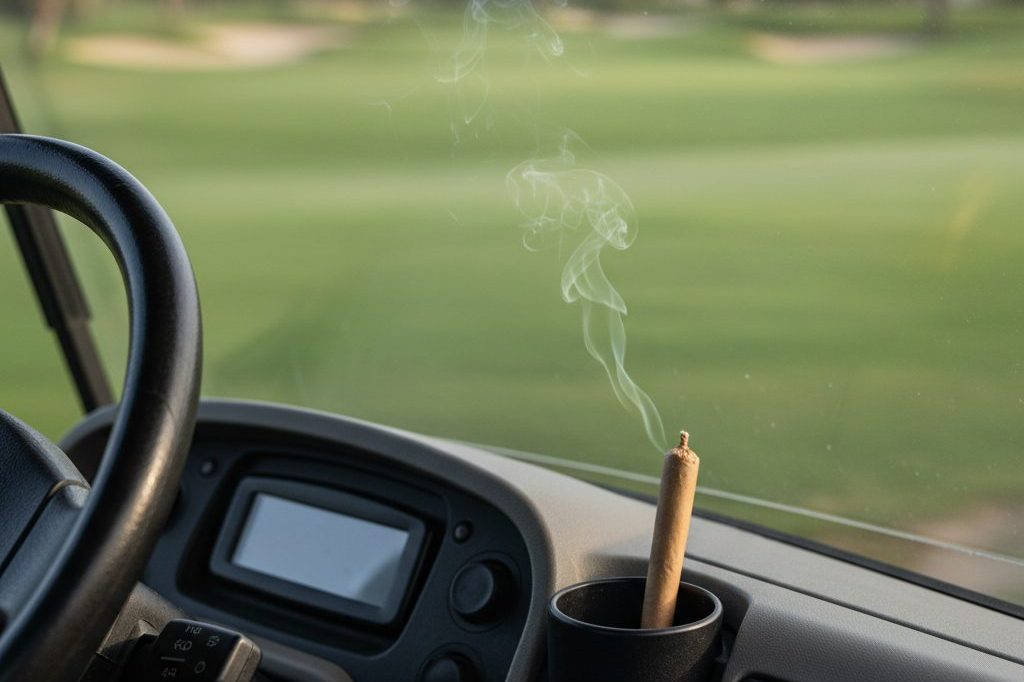
- Don’t exceed the cart driving standard. Cannabis impairment and cart driving are a real concern. Low-dose vape is one thing; heavy dabs before tee time is another.
Edibles vs. Vapes on the Course
The practical consensus among cannabis-friendly golfers:
- Low-dose edibles (2.5–5mg THC) eaten at the turn (between front 9 and back 9) have onset around the 12th or 13th hole and last through the end of the round.
- Vape pens offer more control — a short hit at the 4th tee, another at the 10th. Discreet, odor-light, and finished as fast as a gum.
- Joints and blunts are traditional but carry more smell and visibility. Fine in relaxed groups on public or private courses where policy allows, less discreet in pro-am settings.
Cannabis Is Not a Performance Enhancer
Interestingly, the anti-doping rationale for banning cannabis in competition has weakened as research has shown it’s unlikely to actually help your golf game. In most golfers’ experience, low doses of cannabis make the round more enjoyable without materially shifting the score. Higher doses hurt performance. Which is to say: it’s not doping. It’s a beer equivalent — and the Tours are slowly regulating it like one.
For in-depth cannabis education, dosing guides, safety information, and research summaries, visit our partner site TryCannabis.org