
Last verified: April 2026
The Whole Skill, in One Sentence
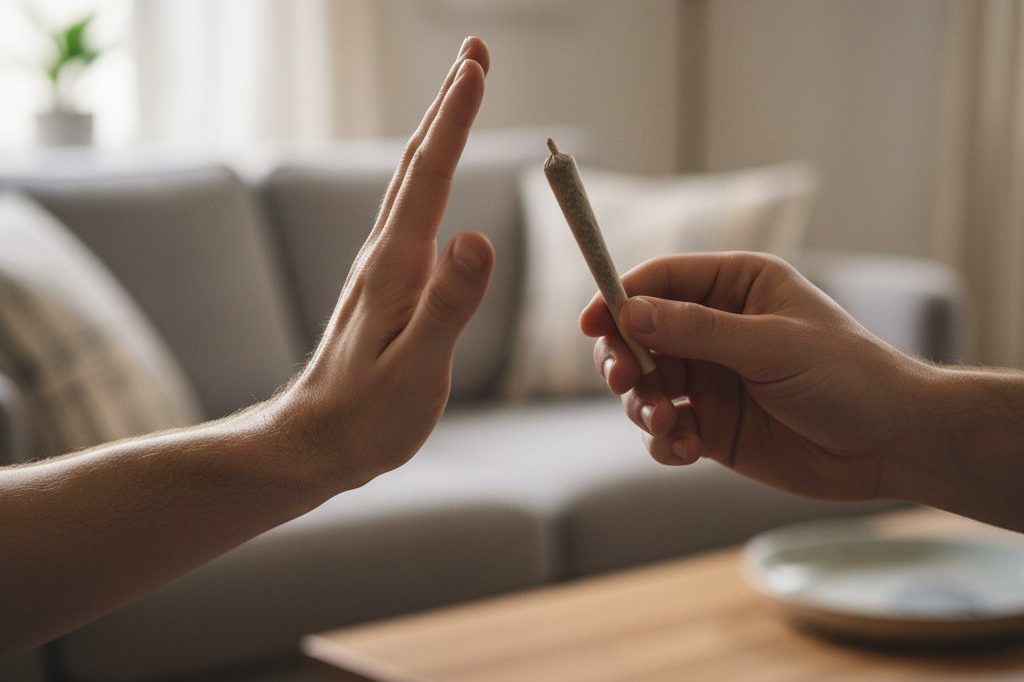
You do not owe anyone an explanation for declining cannabis. Not your reason. Not your history. Not your medical record. Not a sobriety story. Not a work deadline. The correct response, in every setting, is some version of “I’m good, thanks” — said warmly, without apology, and once.
Lizzie Post, writing in Higher Etiquette, captured the principle for everyone on both sides of the pass: “Offer once. Believe them when they say no. Don’t push.” That rule protects you as the person declining, and it protects the person offering from the awkward position of having to read the room twice.
Simple Scripts That Work
All of these land well, across every social setting from a living-room circle to a wedding bud bar:
- “I’m good, thanks.”
- “Not for me tonight.”
- “I’m on a break.”
- “I’m sticking to edibles / tincture / CBD these days.”
- “Pass it on — enjoy.”
- “I’m driving.”
- “Early morning tomorrow.”
- “I’ll hang out, just not partaking.”
Notice what none of these do: they do not apologize. They do not ask permission to decline. They do not explain. They do not leave the conversation open to a follow-up question. A good room hears one of those lines and moves on, and you are still exactly where you were before — in the conversation, in the moment, still a guest.
When you’re not sure what to say, “I’m good, thanks” is the answer every time. It is complete. It is polite. It is final. It does not invite follow-up. Add a smile and maybe a small gesture that sends the joint along (“pass it to Sam”) and you’ve handled the moment perfectly. Anything longer is optional — and often unnecessary.
Why You Don’t Owe a Reason
People decline cannabis for reasons that are deeply private: sobriety, a current medication, a recent rough experience, pregnancy, a job that drug-tests, a religious observance, a mental-health consideration, or simply not feeling like it tonight. None of these deserve to be dragged into a group conversation because a joint reached you. The person offering does not need to know — and, honestly, does not want the social weight of knowing.
A closed-door explanation to a close friend later is fine. A public disclosure at the moment the joint arrives is not required and often not advisable. Modern cannabis culture has, thankfully, mostly retired the expectation that declining requires justification.
If Someone Pushes Anyway
Most people will not push. Most people have internalized the one-offer rule. But occasionally someone will ask twice — either out of genuine hospitality (“you sure?”) or out of a less polished social instinct. A firm, warm second response is fine:
- “Yeah, I’m all set. Really.”
- “Thanks for checking — still a no.”
- “I’m happy watching everyone else enjoy it.”
If someone pushes a third time, that is a them-problem, not a you-problem. You’ve said no twice, clearly. The etiquette violation is theirs. You are free to change the subject, excuse yourself, or say — gently but clearly — “I’ve said no, let’s move on.”
How to Stay in the Social Moment
Declining cannabis does not mean withdrawing from the evening. The best non-consumers at a session look exactly like the consumers: present, talkative, engaged, holding a drink or a snack, laughing at the same jokes. Some practical moves:
- Keep your hands busy. A glass of water, a mocktail, a snack, a camera — any small prop lowers the social pressure to participate.
- Ask about the cannabis. You don’t have to consume to take interest. “What strain is that?” or “Where did you get it?” keeps you inside the conversation.
- Volunteer a non-consumer role. Music, photography, sober rideshare on standby. You become valuable to the group rather than marginal.
- Eat with everyone. Munchies are universal. Non-consumers at a cannabis gathering often enjoy the food more than anyone else.
- Laugh at the stoned jokes. Half the humor of a session is the rambling sincerity. Non-consumers often catch more of it than the people in the circle.
For Hosts: How to Make Declining Easy
If you are hosting, the way you set up the evening determines whether declining feels comfortable or awkward for your guests. A few choices that help everyone:
- Offer a clear non-cannabis alternative. Good food, good drinks, a good playlist. The non-smoker should not feel like they’re at a wedding where the only food is the cake.
- Say up front that declining is fine. “Totally no pressure to partake — I’ve got mocktails and snacks.” That one sentence does enormous work.
- Never announce or tease who’s abstaining. “Sarah’s not smoking tonight” is not useful information for the room. Let guests reveal what they want to reveal.
- Keep the pass moving. If a guest declines, the joint should transit past them smoothly, without a long pause or a comment.
Context-Specific Notes
Weddings and formal events: “I’m sticking to the bar tonight” or “I’m the driver” closes the conversation cleanly.
Work events: “I keep work and cannabis separate” or “Not while I’m on the clock” work fine. You are not obligated to explain personal policy. See the workplace section for more.
Family gatherings: A brief “not tonight” and a deft subject change is usually enough. Families who press tend to press about everything — the issue is rarely cannabis-specific.
First dates: If you don’t consume, saying so early — warmly, without judgment — saves everyone time. “Cannabis isn’t really my thing” does not close a compatible relationship; it clarifies one.
Older adults with younger family: “I’m good, honey” from the grandmother at Thanksgiving is complete. No one pushes Grandma.
The Big Picture
Cannabis etiquette in 2026 is about inclusion — not pressure. The cultural center of gravity has moved firmly toward the view that someone who declines is still fully part of the gathering, not a half-guest. Your “I’m good, thanks” is not a problem to solve. It is the whole conversation. The joint keeps moving. You keep talking. The evening keeps going.
For in-depth cannabis education, dosing guides, safety information, and research summaries, visit our partner site TryCannabis.org